
Helios 44-2: chasing the swirl
I got a new (to me) lens!

And a bonus film camera. (and two bonus vintage telephoto lenses!)
These Helios 44 lenses are fairly well known for having "swirly" or "twisted" bokeh. Fortunately, they were mass-produced and are easy to get a hold of for a reasonable price (kind of).
Notice how there's some weird circular effect going on with the tree? The in focus seagull isn't distorted, but the out of focus background is.

When researching this lens, I found articles and videos referencing this lens's cheap price -- $30-60 dollars! Unfortunately, even though those sources are relatively new (within the last five years), prices are not nearly that low anymore. Ebay listings show people are willing to pay $120-150 (or more!) for these lenses now.
Thanks to the hype surrounding the swirly bokeh, people have been buying these lenses and driving the price up. I am now contributing to the problem.
I have a relatively new copy of the lens (M42 mount, third plant), and
supposedly this generation of the Helios 44 has quality control issues.
But mine is in mint condition! No oil on the aperture blades, the
glass is clean and nearly dust free.
There are actually quite a few variants of this lens, as it was produced for decades in three different manufacturing plants. There are people more knowlegeable than me on this subject, so you can find other sources if you want to learn more. It seems like this was a fairly common kit lens on Zenit cameras. At least for the Zenit E. My Kalimar SR200 is actually just a Zenit E, with a new name on it for an American customer base.
I was not planning on purchasing a film camera. I was trying to find a good deal on a perhaps cosmetically flawed but optically functional Helios 44. It's pretty easy to adapt vintage lenses to a mirrorless system, and my favorite lens for my Fujifilm XT-4 is actually an old Nikon 90mm 1:2 macro lens.
There are pages and pages of Helios 44 lenses on Ebay. And on a whim, I added the word "tested" to my search. That pulled up a listing for a Kalimar SR200 film camera with three lenses, one of which was labeled as a 44mm lens. That lens was in fact the Helios 44, which is (confusingly) a 58mm f2.0 lens.
The seller had set the price for the camera and three lenses at just under $100. The photos looked good. So I purchased everything!
The other two lenses are both telephoto lenses -- one is a 135mm prime and the other is an 80-200mm zoom lens. I took them out this morning and wasn't super impressed by them on my Fujifilm XT-4.
Here's the 135mm telephoto, straight out of camera:

Minimum focus distance isn't bad! And it's pleasant to use. But it's got "character".

I think it needs a lens hood. Or it just has a lot of chromatic aberration naturally. Colors are okay, sharpness is fine for a vintage lens. Just not great performance wide open with harsh light (bird photo). Nothing special.
Here's the zoom. I was definitely trying out the "macro" ability, so most of these are at 200mm and minimum focus distance. I didn't notice that the macro was only 1:5, and minimum focus distance was something like 3 feet. So I'm not really sold on this lens being macro capable.

Some halation. The lens seems kind of soft, but in a pleasing way.

Really nice background separation! The background here is very nicely softened. Colors out of this lens were preferable to the 135mm prime. I think this tended to be sharper all around, but that's not really my priority with vintage lenses.
And here's a bonus shot of a bird very rudely flying off while I tried to get a photo.

I didn't have high hopes for the two other lenses that came with the Helios 44. And I don't think I'll keep either of them. I have a Fujinon 100-400mm lens, which is superior in every way to the 80-400mm zoom. I guess the vintage zoom is much smaller and slightly wider, but when I use the Fujinon, I want the 300-400mm range, the OIS, and the cleaner optics.
The 135mm prime just doesn't really fill a need for me. And I don't really like how the images looked out of the camera. I do very minimal editing, if any, so SOOC image quality is pretty important to me.
Now on to the lens I definitely will be keeping! Everything is SOOC again, no cropping, no exposure fixes, etc.

I think my lens likes to swirl at f2.8 and not really at f2.0.
Here the background is swirled, and the foreground just looks kind of mushy. The lens only swirls the background bokeh:

Very subtle -- I can only see the swirling at the very edges of this image:

Again, a subtle effect just at the edges:

Here's the lens stopped down to (I think) f8. My copy of this lens is really, really sharp stopped down. We get sharpness but no swirling at this aperture.

Same flower, with a more open aperture (f4?). Swirls are just starting to appear -- and we have a flying bug of some sort coming in for a landing!

Another example of how sharp this lens is when stopped down. The background is also pretty soft and blurry in a pleasing way, just not swirly:

So while I will be keeping this lens, I am not sure I'll use it only on my Fuji. I was planning on using it as a walkaround-ish lens for casual use plus some fun swirls, but there are two issues with that.
The first is the size of the lens on my camera.

The lens itself is not that large -- but the adapter almost doubles the length of the lens on my XT-4.
Secondly, the swirl effect is not as pronounced as it could be because I'm using a crop-sensor camera. Since the swirl is more extreme near the edge of the image, I'm "missing" some of the effect due to the crop sensor in my camera.
I'm not going to buy a full-frame camera just to get some swirly bokeh!
However, I do actually already own a full-frame camera. It's just analog. 35mm film is full frame!
The Kalimar SR200/Zenit E is a very sturdy camera. No batteries required. The light meter in mine seems to work, somehow. The shutter sound is deafening and powerful. The camera body is smaller than my XT-4 but somehow weighs just as much. It's got five entire shutter speeds, plus bulb mode. You'll need to convert ASA to ГОСТ to use the light meter. The self-timer on mine works too, and is even louder than the shutter.
Mine is the commemorative 1980s Olympics edition, which I find kind of funny. The US boycotted the Olympics that year for... reasons...
And yet this camera was rebranded into a Kalimar SR200 and sold in the US to an American. Just hilarious!

I shot a roll of cheap film to check the camera for light leaks, shutter issues (though it sounds fine), and to check if the light meter works or not. Hopefully I'll get the scans and negatives back soon! I'm very curious to see if this camera works.
In any case, I managed to get the lens I wanted for a fairly low price, and also a pretty cool film camera, regardless of its functionality.
LA Pride Parade 2023
The LA pride parade seems like it might be a new tradition for me. Last year, I found myself in northern Los Angeles right before the parade started, and was free the rest of the day. So at the last minute, I decided to go. I found myself wanting a real camera (not just my phone) and a bottle of water and sunscreen. But I enjoyed myself thoroughly anyway.
This year I was slightly better prepared. Brought two cameras to overcompensate for a lack of camera last year, and a bottle of water. I skipped the sunscreen though. It was fairly overcast, so I was not punished for my blatant disrespect of our nearest star.

I love this parade. Everyone is happy and enthusiastic and friendly. There's a particular energy and sense of community that I haven't felt at this scale, except here. It is kind of funny seeing large corporations with floats (TikTok, Amazon, Blizzard...) represented, but it's still nice to see that more and more companies are pushing for inclusion and awareness. Even if the majority of their efforts are concentrated toward a single month of the year. It could be better, but it could be far worse.
I took a lot of pictures, and even some videos. Most of the photos are just okay. The autofocus on my camera was necessary to get focus on the moving subjects, but kept locking on to parade watchers in front of me waving flags, which makes sense. Or someone in the background, which is also pretty reasonable, I guess.
I would have loved for this photo to have been focused on the signholder rather than the flag (and I swear it was when I pressed the shutter!), but it's still kind of fun, even though the focus is totally wrong.

I am still getting used to the focus system on my camera (Fujifilm XT-4), plus the new lens (a Fujifilm 27mm f2.8! The pancake!) was another relatively unknown quantity. My most-used lens is a 90mm manual focus lens that I'm very comfortable with now, but it means I simply haven't used the autofocus in my camera much. The best way to learn is to do. And I did get more comfortable with the autofocus system.
Oh, that second camera I mentioned? That's a film camera! A Fujica AX-3, to be exact. I got the camera and lens off ebay very recently.
The film has been dropped off at my local shop, and they estimate two weeks before they deliver the scans. They're pretty swamped at the moment. So, more photos to come (hopefully).
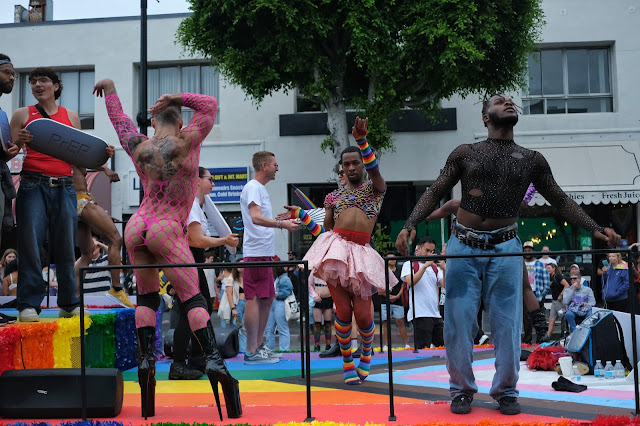
This year there was an emphasis on trans rights. I don't recall as much at the last parade. I assume it's because transgender healthcare and the rights of transgender people are being eroded and actively legislated against in many parts of the US right now.
It was nice to see the support, but it was also a sobering reminder of the grim reality some people must face.

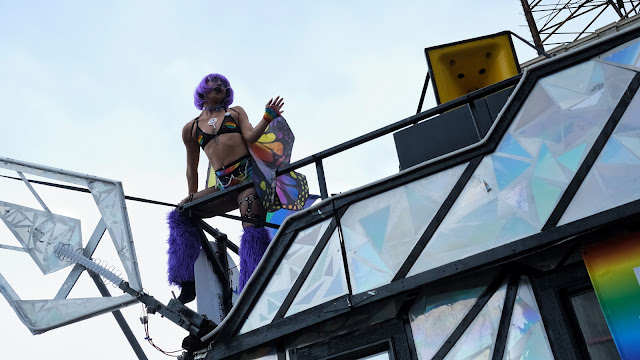
I took a lot of photos of the parade. So many people, so many colors.

This kid was definitely chewing on that flag.


 | |||||




Printing photos with the Fujifilm Instax Link Wide
There's something beautiful about the experience of having a physical photograph. I take a lot of pictures. I've only printed a few. I can't quite say why. It's probably something to do with the whole process of selecting photos, submitting them online, having to wait to pick them up or get them shipped to me. I need some instant gratification!
On a related note, I've wanted an instant camera for a while. I think the draw of having a physical print immediately after pressing the shutter (okay, not immediately, but within minutes) is a compelling reason to purchase one. But I could never justify the purchase. I don't feel confident in producing quality images with the instant cameras' limited controls and features (definitely a spoiled mirrorless camera shooter, but whatever).
Something that fills this gap of wanting instant photos from an instant camera but with digital camera control, and also just getting physical prints is... an instant photo printer!

I think this is the best of both worlds if you want instant photo prints but also the convenience of a smartphone/DSLR/mirrorless camera shooting experience. The Link Wide only works with the smartphone app and maybe the X-S10 (I don't know why my X-T4 isn't supported! Total missed opportunity! This is a Fujifilm camera and printer! It's even got the menu option to connect!), but it's pretty painless to transfer photos to my phone for printing. And then I can select, edit, and print as many copies of any photo I've taken.
I decided I wanted a big print, so I got the biggest of the Instax offerings -- the Link Wide. There's a square and mini photo size as well, but the mini is too small for me, and the square could make fitting normal photos a challenge for me.
(This post is not really a review of the printer, just me rambling a bit, but I am satisfied overall. I can see myself using it consistently for a very long time).
I have printed a lot of photos already. Each photo is about a dollar, so it's definitely not cheaper than ordering prints from my local printer. And the photos are of course on Instax film, not regular photo paper, and they have a washed out, film-like quality. Not true film camera looks. But consistently "old" looking, and I like the aesthetic overall.
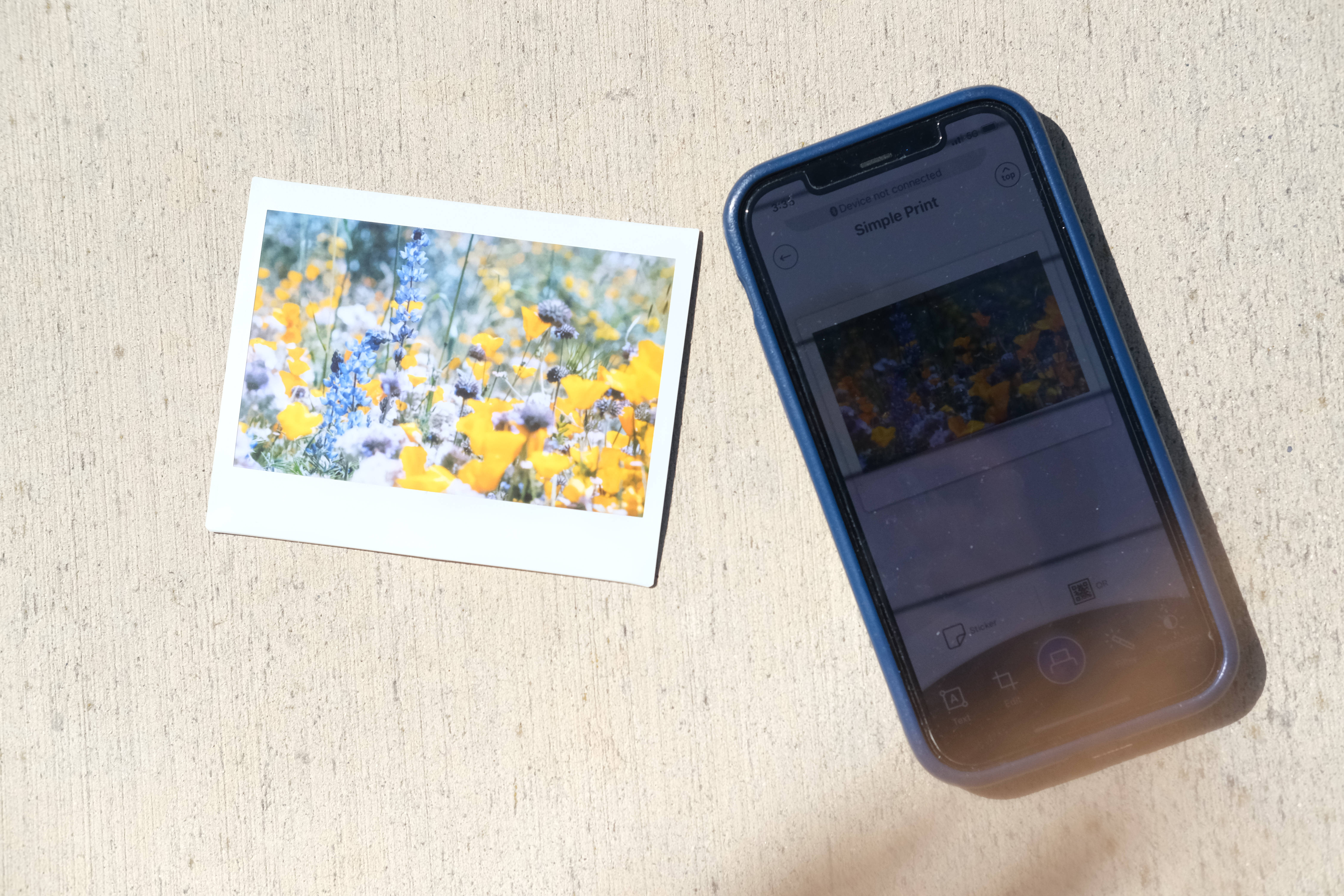
This photo of wildflowers from my X-T4 (unedited, straight from the camera) appears vibrant on the camera screen, my computer screens, and my phone. But I print the photo without editing it, it prints with less vibrant colors, and maybe extra brightness.
 |
| Indoor lighting |
 |
| Outdoors in bright sunlight |
 |
| Outdoors in the shade |
Quality is probably a total waste of the megapixels on my X-T4, but that's fine with me. I'll take the time and money later to get some nice, big prints of photos if I want.
The photo preview and actual print does crop the image slightly. I'm not sure why.
Here's the original image, where the tallest lupine flower's top is in view. Close to the top of the image, but definitely visible.

But app print preview cuts off the top of the image. Taking a closer look at all the edges of the photo, we can see the entire photo has been cropped rather significantly.

I assume this is done to avoid white spaces between the photo and the border. But it's a pretty aggressive crop. I've been adding white space with Snapseed to circumvent this if truly needed.
I usually don't use the filter options. I do sometimes (maybe even a slight majority of the time) use the correction screen to slightly lower brightness and saturation, and slightly increase contrast. This produces images that seem "properly exposed" on the print, since images without adjustment can appear overexposed without edits.
Lowering saturation seems counterintuitive to fix photos coming out missing full color. But I've found that for pictures with people, increasing the saturation can make skin look very warm or orange. Lowering the brightness helps with prints being too light overall, and upping the contrast kind of improves the colors without making people into citrus.
I have been storing the prints in an album designed to hold 5"x7" prints. Two Instax wide prints fit into a 5"x7" space, but must be rotated 90 degrees to fit into this album. There didn't seem to be high-quality albums available for Instax wide prints by default. So I got this one instead. Not the best solution, not the worst either.
(Look, it's the wildflowers photo again! Except I edited in some white borders in Snapseed before editing. I think the app crops slightly less than the preview, so there's white in the top border of the print even though there definitely wasn't when I printed it out).


It holds an extra pack of film, the charging cord, a sharpie, and of course the printer itself.
Diamond lake flowers
I have been neglecting my camera, but I finally got a chance to use it recently. California has received some unprecendented rain this year, and the plants are coming back to life! Everything is green and full of pollen. I have been taking an antihistamine every morning to avoid death by sneezing.
My family combined a trip to my grandmother with a trip to Diamond Lake, where there's a nice trail around part of the artificial lake. This trail is bordered by thick clusters of wildflowers and native grasses of a wide variety of colors and textures, and photos can't really convey how pretty it all is.
I used my XT4 and my 90mm Panagor macro for everything. I did have my 18-55mm, but I find myself using it less and less. I do like it, but just prefer the 90mm for most of what I do with my camera.
The macro lens is good for landscapes (technically it's closer to a 1:2 lens than 1:1 but that is totally fine for my hobbyist needs).


All of these images (except the next, which has been cropped) are straight out of camera. This was early in the morning, maybe 8 am, and the light was bright but not harsh. Colors are rendered accurately and generously. I was excited to get everything into capture one and mess around, but I'm honestly very happy with a lot of images as-is. I do want to spend some time and crop a few, and also do minor adjustments, but the camera and the subject did a good job of making some pleasing photographs.


This lizard was kind enough to hold still. I regret not getting a picture with focus on the head and the tail in frame.

Classic California -- lupines and poppies!

Just some flowers.

A very large grasshopper! Also kind enough to hold still for a few photographs. I don't think I'm 100% happy with any -- the ones where the head is in focus crop some of the tail, and vice versa.

I think this was a thistle of some sort. Looked spiky and dangerous but is actually soft.

I do not know what type of flower these tall stalks are, but they provide some visual interest rising above the bright poppies below.

One of my favorites from the day. Just some flowers, being pretty.

More lupines!

A bi-colored flower of some sort. I saw bees frequenting these flowers but did not get a useable image of a bee all day.

Some pretty grasses!

This is one of the early shots when I was figuring out the right exposure/aperture for the day. Turned out very dark overall but I like the effect.

And on the other hand, the brightness of this one just works.

I like these curly flowers.

A pollinator! Poor framing, but this is the only image I got, as it was spooked immediately after and flew away. Some cropping will help the composition.