
First (ish) roll from my new to me Kalimar SR200
A few weeks ago, I got a Helios 44 lens, which happened to be attached to a Kalimar SR200/Zenit E camera. The seller wasn't sure the camera worked, but mechanically, it seemed to function. The light meter even seemed to work!
The first roll I shot in the camera came out totally blank. Which was disappointing. I think the issue is the film holder is very fiddly, either from wear or age. But I'm happy to report that the second roll was totally fine! I got 32 photos, despite the back being opened once accidentally during rewinding...

These are the small-sized scans from my local photo lab. I think this is Fuji 200 film. I've tweaked the colors, crop, and alignment in capture one slightly. The photos with bugs in them have been cropped rather severely though (the Helios is not a macro lens, though it does have a fairly short minimum focus distance).
I took most of these images on a quick coastside stop back from a camera shop where I gave them the 135mm lens that also came with this camera. Like me, they assessed it as being worth no money, but were happy to take it and try to sell it for $5 or so to someone who might be in need of it. I'm hopeful it'll find its way to someone who will appreciate it and put it to good use. It was in very good shape, just a focal length that was already covered by three of my other lenses on various systems.
Anyway. These photos were all shot with the Helios 44. It was kind of fun shooting the camera with its kit lens. I didn't trust the light meter at this point, so these were all taken on a sunny day, at f16 and shutter speed 250, for my 200 ASA film.
These are kind of throwaway shots, because I didn't think the camera worked, and had just run another roll of film through it that came out blank. I think that first blank roll was user error, somehow. I'm still not sure what went wrong. In any case, I did get some images that I enjoy off of this second roll!
 |
| Cropped, straightened, and colors adjusted |
 |
| Cropped very much! Colors adjusted. |
 |
| Just fixed the alignment here. |
 |
| Three oil rigs in the distance... |
There's definitely something funky happening in most of these photos. I think most of the issues are due to the back being opened while film was being rewound. I had rewound more than half of the roll and I don't have much intuition for how long I should be rewinding, having only rewound five entire rolls of film before, this being the fifth.
The film spool popped up and offered no resistance when turned, and didn't seem to want to go back inside the camera, so I opened up the back. There was definitely film visible... So I'm hoping the optical defects and light leaks are a result of that, rather than something with the camera.
 |
| Cropped to be vertically oriented. I think this might be f11 or f8. |
 |
| Slightly changed some colors. |
 |
| Cropped, colors adjusted. The petals and the bee are very crisp here, this lens is sharp! |
 |
| An "artistic" light leak over the stop sign. Colors adjusted. |
 |
| Colors adjusted. Taken from the top of a parking garage. |
 |
| Cropped, colors adjusted. |
 |
| Pretty much "straight out of camera" -- light issues very apparent here. |
Maybe I'll keep that zoom lens after all...
I overlooked a couple things when testing that vintage telephoto lens from my last post.
1) The included extension tubes!
2) My micro four thirds camera!

The huge working distance for this lens and the 1:5 reproduction ratio was a disadvantage for me. Extension tubes address that, somewhat. I don't think I would use this lens as a telephoto -- if I use it, it'll be for macro. So the loss of infinity focus isn't an issue here.
And a micro four thirds camera "doubles" focal length of full-frame lenses. So the 80-200mm becomes a 160-400mm. That's pretty close to my Fujinon 100-400mm (which is more like 150-600 full frame equivalent on my crop sensor X-T4).
Here's the sandwich. Lens, extension tube, M42 to MFT adapter, Olympus camera:

I think this is still less weight than the X-T4's body. (Probably not).
Finding focus is much harder though. The very short distance that is in focus is difficult to find quickly, at least for me right now. I should probably make myself a chart for how the extension tube modifies minimum and maximum focus distances for 80 v 200mm.
This one is straight from the Olympus:

These next two have been cropped and slightly color corrected:


It was very windy and I was losing the light, so these are pretty much the only in focus and decent shots I got. But I see the potential of this lens now!
Helios 44-2: chasing the swirl
I got a new (to me) lens!

And a bonus film camera. (and two bonus vintage telephoto lenses!)
These Helios 44 lenses are fairly well known for having "swirly" or "twisted" bokeh. Fortunately, they were mass-produced and are easy to get a hold of for a reasonable price (kind of).
Notice how there's some weird circular effect going on with the tree? The in focus seagull isn't distorted, but the out of focus background is.

When researching this lens, I found articles and videos referencing this lens's cheap price -- $30-60 dollars! Unfortunately, even though those sources are relatively new (within the last five years), prices are not nearly that low anymore. Ebay listings show people are willing to pay $120-150 (or more!) for these lenses now.
Thanks to the hype surrounding the swirly bokeh, people have been buying these lenses and driving the price up. I am now contributing to the problem.
I have a relatively new copy of the lens (M42 mount, third plant), and
supposedly this generation of the Helios 44 has quality control issues.
But mine is in mint condition! No oil on the aperture blades, the
glass is clean and nearly dust free.
There are actually quite a few variants of this lens, as it was produced for decades in three different manufacturing plants. There are people more knowlegeable than me on this subject, so you can find other sources if you want to learn more. It seems like this was a fairly common kit lens on Zenit cameras. At least for the Zenit E. My Kalimar SR200 is actually just a Zenit E, with a new name on it for an American customer base.
I was not planning on purchasing a film camera. I was trying to find a good deal on a perhaps cosmetically flawed but optically functional Helios 44. It's pretty easy to adapt vintage lenses to a mirrorless system, and my favorite lens for my Fujifilm XT-4 is actually an old Nikon 90mm 1:2 macro lens.
There are pages and pages of Helios 44 lenses on Ebay. And on a whim, I added the word "tested" to my search. That pulled up a listing for a Kalimar SR200 film camera with three lenses, one of which was labeled as a 44mm lens. That lens was in fact the Helios 44, which is (confusingly) a 58mm f2.0 lens.
The seller had set the price for the camera and three lenses at just under $100. The photos looked good. So I purchased everything!
The other two lenses are both telephoto lenses -- one is a 135mm prime and the other is an 80-200mm zoom lens. I took them out this morning and wasn't super impressed by them on my Fujifilm XT-4.
Here's the 135mm telephoto, straight out of camera:

Minimum focus distance isn't bad! And it's pleasant to use. But it's got "character".

I think it needs a lens hood. Or it just has a lot of chromatic aberration naturally. Colors are okay, sharpness is fine for a vintage lens. Just not great performance wide open with harsh light (bird photo). Nothing special.
Here's the zoom. I was definitely trying out the "macro" ability, so most of these are at 200mm and minimum focus distance. I didn't notice that the macro was only 1:5, and minimum focus distance was something like 3 feet. So I'm not really sold on this lens being macro capable.

Some halation. The lens seems kind of soft, but in a pleasing way.

Really nice background separation! The background here is very nicely softened. Colors out of this lens were preferable to the 135mm prime. I think this tended to be sharper all around, but that's not really my priority with vintage lenses.
And here's a bonus shot of a bird very rudely flying off while I tried to get a photo.

I didn't have high hopes for the two other lenses that came with the Helios 44. And I don't think I'll keep either of them. I have a Fujinon 100-400mm lens, which is superior in every way to the 80-400mm zoom. I guess the vintage zoom is much smaller and slightly wider, but when I use the Fujinon, I want the 300-400mm range, the OIS, and the cleaner optics.
The 135mm prime just doesn't really fill a need for me. And I don't really like how the images looked out of the camera. I do very minimal editing, if any, so SOOC image quality is pretty important to me.
Now on to the lens I definitely will be keeping! Everything is SOOC again, no cropping, no exposure fixes, etc.

I think my lens likes to swirl at f2.8 and not really at f2.0.
Here the background is swirled, and the foreground just looks kind of mushy. The lens only swirls the background bokeh:

Very subtle -- I can only see the swirling at the very edges of this image:

Again, a subtle effect just at the edges:

Here's the lens stopped down to (I think) f8. My copy of this lens is really, really sharp stopped down. We get sharpness but no swirling at this aperture.

Same flower, with a more open aperture (f4?). Swirls are just starting to appear -- and we have a flying bug of some sort coming in for a landing!

Another example of how sharp this lens is when stopped down. The background is also pretty soft and blurry in a pleasing way, just not swirly:

So while I will be keeping this lens, I am not sure I'll use it only on my Fuji. I was planning on using it as a walkaround-ish lens for casual use plus some fun swirls, but there are two issues with that.
The first is the size of the lens on my camera.

The lens itself is not that large -- but the adapter almost doubles the length of the lens on my XT-4.
Secondly, the swirl effect is not as pronounced as it could be because I'm using a crop-sensor camera. Since the swirl is more extreme near the edge of the image, I'm "missing" some of the effect due to the crop sensor in my camera.
I'm not going to buy a full-frame camera just to get some swirly bokeh!
However, I do actually already own a full-frame camera. It's just analog. 35mm film is full frame!
The Kalimar SR200/Zenit E is a very sturdy camera. No batteries required. The light meter in mine seems to work, somehow. The shutter sound is deafening and powerful. The camera body is smaller than my XT-4 but somehow weighs just as much. It's got five entire shutter speeds, plus bulb mode. You'll need to convert ASA to ГОСТ to use the light meter. The self-timer on mine works too, and is even louder than the shutter.
Mine is the commemorative 1980s Olympics edition, which I find kind of funny. The US boycotted the Olympics that year for... reasons...
And yet this camera was rebranded into a Kalimar SR200 and sold in the US to an American. Just hilarious!

I shot a roll of cheap film to check the camera for light leaks, shutter issues (though it sounds fine), and to check if the light meter works or not. Hopefully I'll get the scans and negatives back soon! I'm very curious to see if this camera works.
In any case, I managed to get the lens I wanted for a fairly low price, and also a pretty cool film camera, regardless of its functionality.
Shooting on film (but, why?)
Long story short, film YouTube convinced me to try shooting film. People were having fun, talked about how different the experience was versus shooting digitally, etc. I was also really enjoying my instant photo printer (which I wrote about here), which kind of adds an old-school aesthetic to prints. I did some basic research and found that buying a used film camera off eBay wouldn't actually be too expensive. So I got one! The first roll revealed the camera had some pretty significant light leaks:

Even though it's unusable as an image, there's still something about the look that a digital camera and lots of post-processing would struggle to replicate.
And I "get" film now.
I get why people are still shooting film, even if it costs nearly $30 for 36 photos (cost of film, development, and scanning). The experience and result is so fundamentally different.
I think I've used disposable cameras before, so technically I'm not totally new to film. Those can still be bought new today. But I don't think anyone's making new film cameras (other than instant cameras, and a newly-announced/not-yet-released camera by Pentax/Ricoch).
If you don't have a camera, you have to buy one online or in a thrift store, etc. I opted for the online route, as none of my local stores had anything suitable (I found some massive vintage zooms lenses, but no camera bodies).
Since I already have a Fujifilm XT-4, I thought I would get a Fujifilm analog camera, so I could use my same lenses. And as the new Fujifilm cameras use the X mount, and the old Fujica cameras also use a lens mounting system called the X mount, I figured I could just buy a camera body and use a lens I already have.
I also wanted a fully-mechanical camera body, and with some very basic research, decided on the STX-2. I saw that the AX-3 was a fairly comparable option, being mostly mechanical, but found an STX-2 body for a very good price, and fully functional. So I ordered it!
And then I found that the X mount for modern digital cameras is actually not the same as the X mount for older Fujifilm cameras. Terrible naming conventions.
I went back to eBay and started looking for lenses that would be compatible with the camera. I found a new-in-box 28mm f2.8 Toyo Optics lens, which was a very cool find. A long-standing camera store was going out of business, and liquidated their entire stock online. They had a few other very old, very random bits and ends.

Think the warranty is still good?
I also found an AX-3 being sold "as-is". But it had the 50mm lens I was trying to find, so I bought the whole thing, just for the lens. That turned out to be a very, very good thing.
The STX-2 body that I ordered never showed up. The tracking did not update, and the seller ended up refunding me. I think it got lost in the mail. Still hasn't shown up.
The AX-3 was a bit dinged up, but fully operational. Other than the pretty bad light leaks. I got a light seal foam kit and replaced the ancient, disintegrating foam, which hopefully fixed the issue. I haven't gotten the test film back yet to see.
So in the end, I have a single AX-3, plus a 28mm and a 50mm lens. I think that's a fully functional film camera collection for my needs. I hope I never get interested in medium or large format or any of the other film-related things that cost the big bucks.


Another image from that first roll. Light leak is very apparent, again!
The rest of the photos are about the same. Light leak, random subjects, missed focus about half the time.
Shooting the roll was very fun though. Even though I wasn't sure the camera was working (I could hear the shutter and it appeared the film was winding properly), I found myself taking a lot of time composing shots, considering shutter speed and aperture...
Considering each shutter press was about a dollar, compared to my near-free shutter presses on my XT-4, of course I was going to take my time!
I only got 10 actual images from this first roll, actually. Half the roll was totally burnt out, probably due to the light leak. So, 10 pictures for $30 is more like $3 per photo, which will add up quickly.
Even so, I enjoyed the experience, and have since shot three more rolls of film. Hopefully the light leak is fixed, hopefully the focus is right, hopefully I get some nice images.
LA Pride Parade 2023
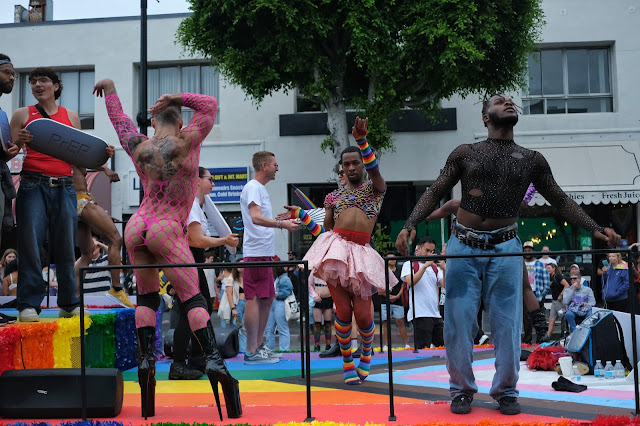
The LA pride parade seems like it might be a new tradition for me. Last year, I found myself in northern Los Angeles right before the parade started, and was free the rest of the day. So at the last minute, I decided to go. I found myself wanting a real camera (not just my phone) and a bottle of water and sunscreen. But I enjoyed myself thoroughly anyway.
This year I was slightly better prepared. Brought two cameras to overcompensate for a lack of camera last year, and a bottle of water. I skipped the sunscreen though. It was fairly overcast, so I was not punished for my blatant disrespect of our nearest star.

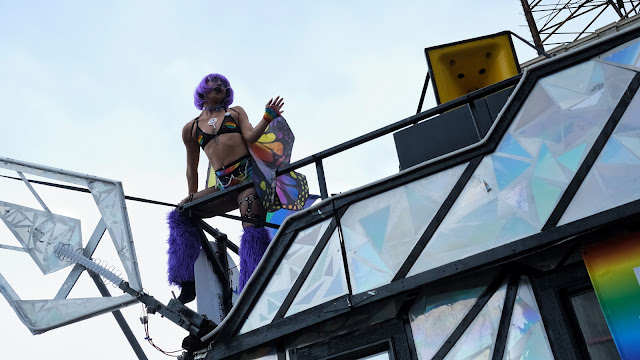
I love this parade. Everyone is happy and enthusiastic and friendly. There's a particular energy and sense of community that I haven't felt at this scale, except here. It is kind of funny seeing large corporations with floats (TikTok, Amazon, Blizzard...) represented, but it's still nice to see that more and more companies are pushing for inclusion and awareness. Even if the majority of their efforts are concentrated toward a single month of the year. It could be better, but it could be far worse.
I took a lot of pictures, and even some videos. Most of the photos are just okay. The autofocus on my camera was necessary to get focus on the moving subjects, but kept locking on to parade watchers in front of me waving flags, which makes sense. Or someone in the background, which is also pretty reasonable, I guess.
I would have loved for this photo to have been focused on the signholder rather than the flag (and I swear it was when I pressed the shutter!), but it's still kind of fun, even though the focus is totally wrong.

I am still getting used to the focus system on my camera (Fujifilm XT-4), plus the new lens (a Fujifilm 27mm f2.8! The pancake!) was another relatively unknown quantity. My most-used lens is a 90mm manual focus lens that I'm very comfortable with now, but it means I simply haven't used the autofocus in my camera much. The best way to learn is to do. And I did get more comfortable with the autofocus system.
Oh, that second camera I mentioned? That's a film camera! A Fujica AX-3, to be exact. I got the camera and lens off ebay very recently.
The film has been dropped off at my local shop, and they estimate two weeks before they deliver the scans. They're pretty swamped at the moment. So, more photos to come (hopefully).
This year there was an emphasis on trans rights. I don't recall as much at the last parade. I assume it's because transgender healthcare and the rights of transgender people are being eroded and actively legislated against in many parts of the US right now.
It was nice to see the support, but it was also a sobering reminder of the grim reality some people must face.

I took a lot of photos of the parade. So many people, so many colors.

This kid was definitely chewing on that flag.


 | |||||




Printing photos with the Fujifilm Instax Link Wide
There's something beautiful about the experience of having a physical photograph. I take a lot of pictures. I've only printed a few. I can't quite say why. It's probably something to do with the whole process of selecting photos, submitting them online, having to wait to pick them up or get them shipped to me. I need some instant gratification!
On a related note, I've wanted an instant camera for a while. I think the draw of having a physical print immediately after pressing the shutter (okay, not immediately, but within minutes) is a compelling reason to purchase one. But I could never justify the purchase. I don't feel confident in producing quality images with the instant cameras' limited controls and features (definitely a spoiled mirrorless camera shooter, but whatever).
Something that fills this gap of wanting instant photos from an instant camera but with digital camera control, and also just getting physical prints is... an instant photo printer!

I think this is the best of both worlds if you want instant photo prints but also the convenience of a smartphone/DSLR/mirrorless camera shooting experience. The Link Wide only works with the smartphone app and maybe the X-S10 (I don't know why my X-T4 isn't supported! Total missed opportunity! This is a Fujifilm camera and printer! It's even got the menu option to connect!), but it's pretty painless to transfer photos to my phone for printing. And then I can select, edit, and print as many copies of any photo I've taken.
I decided I wanted a big print, so I got the biggest of the Instax offerings -- the Link Wide. There's a square and mini photo size as well, but the mini is too small for me, and the square could make fitting normal photos a challenge for me.
(This post is not really a review of the printer, just me rambling a bit, but I am satisfied overall. I can see myself using it consistently for a very long time).
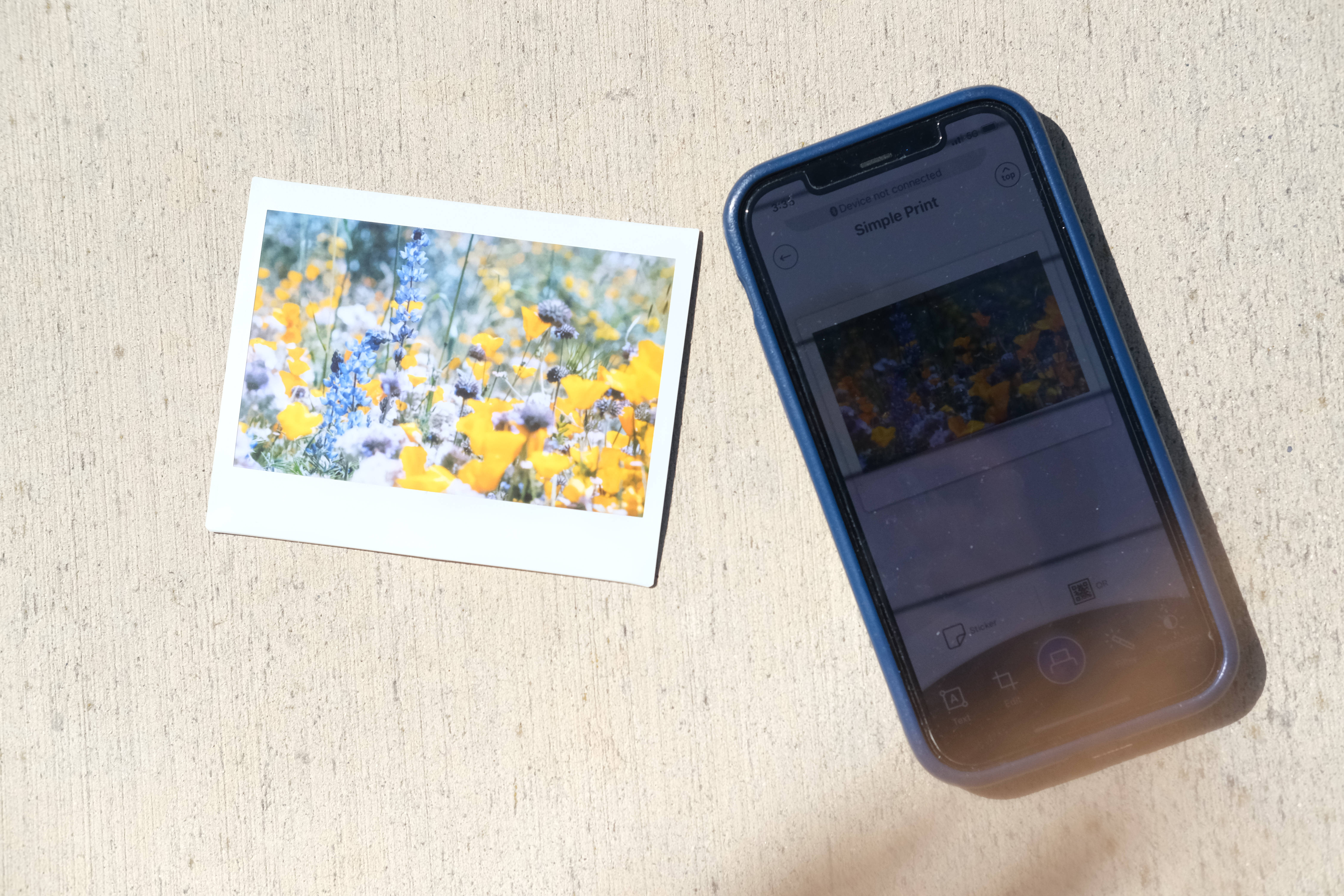
I have printed a lot of photos already. Each photo is about a dollar, so it's definitely not cheaper than ordering prints from my local printer. And the photos are of course on Instax film, not regular photo paper, and they have a washed out, film-like quality. Not true film camera looks. But consistently "old" looking, and I like the aesthetic overall.
This photo of wildflowers from my X-T4 (unedited, straight from the camera) appears vibrant on the camera screen, my computer screens, and my phone. But I print the photo without editing it, it prints with less vibrant colors, and maybe extra brightness.
 |
| Indoor lighting |
 |
| Outdoors in bright sunlight |
 |
| Outdoors in the shade |
Quality is probably a total waste of the megapixels on my X-T4, but that's fine with me. I'll take the time and money later to get some nice, big prints of photos if I want.
The photo preview and actual print does crop the image slightly. I'm not sure why.
Here's the original image, where the tallest lupine flower's top is in view. Close to the top of the image, but definitely visible.

But app print preview cuts off the top of the image. Taking a closer look at all the edges of the photo, we can see the entire photo has been cropped rather significantly.

I assume this is done to avoid white spaces between the photo and the border. But it's a pretty aggressive crop. I've been adding white space with Snapseed to circumvent this if truly needed.
I usually don't use the filter options. I do sometimes (maybe even a slight majority of the time) use the correction screen to slightly lower brightness and saturation, and slightly increase contrast. This produces images that seem "properly exposed" on the print, since images without adjustment can appear overexposed without edits.
Lowering saturation seems counterintuitive to fix photos coming out missing full color. But I've found that for pictures with people, increasing the saturation can make skin look very warm or orange. Lowering the brightness helps with prints being too light overall, and upping the contrast kind of improves the colors without making people into citrus.
I have been storing the prints in an album designed to hold 5"x7" prints. Two Instax wide prints fit into a 5"x7" space, but must be rotated 90 degrees to fit into this album. There didn't seem to be high-quality albums available for Instax wide prints by default. So I got this one instead. Not the best solution, not the worst either.
(Look, it's the wildflowers photo again! Except I edited in some white borders in Snapseed before editing. I think the app crops slightly less than the preview, so there's white in the top border of the print even though there definitely wasn't when I printed it out).


It holds an extra pack of film, the charging cord, a sharpie, and of course the printer itself.
Diamond lake flowers
I have been neglecting my camera, but I finally got a chance to use it recently. California has received some unprecendented rain this year, and the plants are coming back to life! Everything is green and full of pollen. I have been taking an antihistamine every morning to avoid death by sneezing.
My family combined a trip to my grandmother with a trip to Diamond Lake, where there's a nice trail around part of the artificial lake. This trail is bordered by thick clusters of wildflowers and native grasses of a wide variety of colors and textures, and photos can't really convey how pretty it all is.
I used my XT4 and my 90mm Panagor macro for everything. I did have my 18-55mm, but I find myself using it less and less. I do like it, but just prefer the 90mm for most of what I do with my camera.
The macro lens is good for landscapes (technically it's closer to a 1:2 lens than 1:1 but that is totally fine for my hobbyist needs).


All of these images (except the next, which has been cropped) are straight out of camera. This was early in the morning, maybe 8 am, and the light was bright but not harsh. Colors are rendered accurately and generously. I was excited to get everything into capture one and mess around, but I'm honestly very happy with a lot of images as-is. I do want to spend some time and crop a few, and also do minor adjustments, but the camera and the subject did a good job of making some pleasing photographs.


This lizard was kind enough to hold still. I regret not getting a picture with focus on the head and the tail in frame.

Classic California -- lupines and poppies!

Just some flowers.

A very large grasshopper! Also kind enough to hold still for a few photographs. I don't think I'm 100% happy with any -- the ones where the head is in focus crop some of the tail, and vice versa.

I think this was a thistle of some sort. Looked spiky and dangerous but is actually soft.

I do not know what type of flower these tall stalks are, but they provide some visual interest rising above the bright poppies below.

One of my favorites from the day. Just some flowers, being pretty.

More lupines!

A bi-colored flower of some sort. I saw bees frequenting these flowers but did not get a useable image of a bee all day.

Some pretty grasses!

This is one of the early shots when I was figuring out the right exposure/aperture for the day. Turned out very dark overall but I like the effect.

And on the other hand, the brightness of this one just works.

I like these curly flowers.

A pollinator! Poor framing, but this is the only image I got, as it was spooked immediately after and flew away. Some cropping will help the composition.
More macro!
I went out again today and took more pictures. The sky was still very overcast, but I went out in the afternoon, so there was more light. I took my tripod with me but didn't end up using it because I was walking around so much, and I could generally get sharp "enough" images after a few tries.
The first thing I happened to photograph was this cute butterfly that kept walking around on the flower and didn't want to be photographed.
 |
| Photo op! |
I got a few more pictures of it, though not any great ones.
 |
| "Cinematic" (ha) crop at 16:9. I think the antennae is in focus but the rest of the butterfly is not. Oops. |
This is my favorite one, even though it's the butterfly butt and it's mostly out of focus. You can see the scales on the wing and the shallow depth of field creates an interesting effect in my opinion. I'm amazed at the detail I was able to capture!
 |
| Butterfly butt! |
 |
| Some sort of daisy. Still slightly more blurry than I'd like. |
 |
| Yummy eucalyptus leaves! Don't eat these unless you're a koala, or whatever bug is eating them here. |
I also re-tried the "use the macro lens as a telephoto lens" thing and had mixed results. After a lot of modification in Capture One Express (exposure down, contrast way up, brightness up), the images look closer to real life. I think the contrast is the biggest thing missing from the straight-out-of camera images.
 |
| Super weird to see banana trees in an area with oak/eucalyptus. Apparently this area had a nursery and they just left some plants when they closed up shop. |
 |
| Yes, need to clean my sensor. But also -- look at those brave people! |
Still excited to use this lens even more. I hope that there's better light next weekend. And in a month or so, monarch butterflies should be migrating and taking their annual break very close to me -- hopefully I can find a time with fewer people to visit in a COVID-friendly way.
First pictures with a Panagor 90mm, f/2.8, 1:1 macro lens (and "my" Nikon D40)
I have a Nikon D40. It is a relatively old crop-sensor DSLR (announced in 2006!), and it isn't actually mine. It's my dad's camera. But I borrowed it and he hasn't needed it back yet, so it lives with me. It has a whopping 6.1 MP, can shoot up to 2.5 frames per second, and 3 auto-focus points. It cannot do video.
However, it definitely works and takes pictures!
I've wanted a macro lens for quite a long time. The only thing stopping me from getting one is the cost of macro lenses. They are, to put it lightly, incredibly expensive. And I wasn't sure I wanted to invest a lot of money for a nice lens if I wasn't sure I was going to stick with a Nikon body for the future, since I do want to upgrade to a newer camera soon.
Two days ago, I found a listing on craigslist for a $95 macro lens, Nikon F-mount. Too enticing to pass up! I bought it from the seller today.
 |
| Each of these dead flower buds was about an inch wide! Not super sharp, yay for unsteady hands. |
The lens is totally manual. Aperture and focus are controlled on the lens, and it's so old that it doesn't communicate with the camera at all. So images don't save with aperture info, and I also don't get exposure information -- lots of test images are needed.
Here's the lens fully retracted:


My SO made some, ahem, colorful remarks about this lens's ability to elongate so magnificently.
The markings on the lens are still sort of a mystery to me. I know some correspond to magnification level, and some appear to be distance to object for focus. There are still a few I haven't figured out though.
The focus ring is nice and heavy -- it takes quite a few turns to get from one end to the other though, definitely not something that would be fun to use for a fast-moving subject. The aperture dial has clicks for half stops as well, and is a little less clicky/heavy as the one on my Rokinon, but still nice to use.
The lens is in very good condition and works beautifully as a macro lens. It's a pretty bad telephoto lens, but can produce some passable shots. Doesn't seem to do portraits well, but would make some interesting photos, I think.
My main issue in picture-taking is my really shaky hands, and without any stabilization in the lens or in the body, I generally need a very fast shutter speed and very wide aperture to take sharp pictures, plus good light. (Tripods would help, of course, but they're heavy and slow to set up). That means very shallow depth of field, and if the subject moves (wind!), the picture gets blurry all over again.
Right after I picked up the lens, I went out to a fairly secluded area (because COVID) and took some pictures. It was overcast, and the light disappeared pretty quickly after the first thirty minutes, and it was also pretty breezy, but I did get some nice pictures. I also got a ton of terrible, blurry pictures. Have I mentioned my shaky hands?
I'm excited to go out again and re-try with better light!
 | |
| The very first picture I took (with the "proper" exposure, more or less). I hadn't bought the lens just yet... |
 | |||||||||||||||||||||||||||||||||||||||||||||
| One of the next few, right after I bought the lens! No blurring added in post, no cropping. 1:1 magnification and slightly blurry, but still awesome. The plant was a couple feet across and this is just the center. |
 |
| Dead flowers. |
 |
| More dead flowers! Different type this time. |
 |
| Dead grass. (Notice a trend? It's autumn, everything is dead right now). |
 | |
| Using the macro lens as a "regular" lens. These are the same flowers as in the first picture of dead flowers. |
 |
| Go Gauchos! Trying to mimic a telephoto. This was the sharpest it wanted to get. Pretty dang fuzzy, even for the D40. |
 |
| Better attempt at a telephoto lens. Taken from the top of a hill, ~50 feet away from the birds. |
Read More
When it rains, it pours
 |
| Typical shot of water on leaves. |
 |
| Spiderwebs look awesome when they catch the rain like this. |
 |
| My favorite shot of the day. |
Visiting the Getty
I brought along my camera and new lens (Nikon D40 and Rokinon 14mm 2.8). I also brought a 35mm prime lens for the pictures, since the Getty's website said non-flash photography was permissible and I wanted pictures of the artwork inside.
I had never seen the museum itself, and honestly I would have been happy walking around the outside and on the grounds for the entire day. The museum is situated at the top of a hill overlooking Los Angeles, and is a very modern-looking, artsy building.
I got a lot of pictures of just the building with my new lens. My mom was rather unimpressed with the shots...
 |
| 35mm |
 |
| 35mm |
 |
| 35mm |
 |
| 35mm |
 |
| 35mm |
 |
| 14mm |
The lines are clean and the building looks amazing from basically every angle.
The views of Los Angeles were really good as well. All of these were taken with the 14mm.
 |
| From the back of the Getty, looking out at the city. Mmm, smog. |
 |
| Walking back down. We could all see where the fire burned. Didn't look like any houses got burned! |
I took a lot of pictures, but didn't take pictures of the artist name/context for the work...
What I do remember is my favorite one, Renoir's La Promenade.
 |
| Renoir's La Promenade. |
At the time he painted it, he was studying with Monet, so his paintings took on a more impressionist feeling. Which was a perfect way to express the dappled light, I think.
And there were a few Monets.
 |
| Haystacks! I think the caption called them Wheatstacks though. |
We also ate lunch in the museum cafe. It was very, very expensive. The upstairs restaurant charged about $35 per plate of food, and just an appetizer was $15. The cafe downstairs was cheaper, but still exorbitant for the food you got.
Unfortunately I was hungry from a small breakfast and four hours of walking and photographing and I needed to eat there... My brother waited till we went to Chik Fil A and got about the same amount of food for less than half the price!
New camera lens (Rokinon 14mm, f2.8 Nikon AE)
 |
| f22, 10 seconds. The detail on the highway blew me away. |
 |
| f22, 15 seconds. Bright lights = stars! |
 |
| f22, 30 seconds. Can you see the mustache distortion? |